USF sells college radio station
University of San Francisco’s 34-year-old, volunteer-staffed radio station KUSF was pulled of the FM airwaves Jan. 19 and is being transitioned to an online-only format — a decision made without the station staff’s knowledge.
By Isaiah Kramer
The Guardsman
University of San Francisco’s 34-year-old, volunteer-staffed radio station KUSF was pulled off the FM airwaves Jan. 19 and is being transitioned to an online-only format — a decision made without the station staff’s knowledge.
University President Stephen Privett made the decision when classical music station KDFC offered to buy KUSF for $3.75 million.
Privett signed a non-disclosure agreement that prohibited him from alerting students, teachers or even the station itself of the sale.
“When I was at KUSF and I was thrown out, I didn’t feel like a student. I felt like a criminal,” KUSF student recruiter Chad Heimann said.
Privett said the motivation behind the sale was to reinvest $3.75 million into the university to benefit students. KUSF will continue online as a student-run station — excluding the volunteer staff and DJs, some who have been at the station for three decades and helped make it a foundation of the community that at one time had programs in 13 different languages.
Station supporters said he abandoned his Jesuit ideals by turning his back on the community and accused him of making a crass business deal without regard for the value of the radio station. Supporters also chided him for signing and hiding behind the non-disclosure agreement that kept everyone in the dark.
“It’s a cultural institution, and the only station in San Francisco that has consistently supported underground and emerging artists,” music promoter Larry Rudis said.
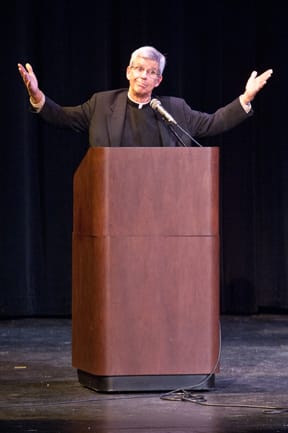
After a day of silence on the part of the administration, KUSF organized a meeting at the USF Presentation Theatre on the evening of Jan. 19. There, Privett confronted the KUSF community and attempted to address their concerns.
“All of our questions have importance tonight,” KUSF Music Director Irwin Swirnoff said. “We are here to get answers.”
Rallying to the cries of distress sent out via KUSF’s Twitter feed and Facebook page, the audience — which included students, alumni, staff, local musicians and San Francisco Supervisor Ross Mirkarimi — filled the auditorium to standing-room-only capacity.
Security opened the theatre balcony, allowing KUSF supporters to enter. The whole room reverberated with the five-syllable protest chant, “Shame on U-S-F.”
“It’s very clear to me that there is justifiable anger and grief about the decision I made,” Privett said in opening. “As a university our responsibility is to our students. It [KUSF] was of tremendous benefit to the community but minimal benefit to the students.”
He said that because the station was funded by student tuition, he didn’t think it was fair for it to primarily benefit the community.
The audience grew louder, especially several outraged students, to rebuke Privett’s position. Every time he spoke the audience reacted with heckling or a roar of objections.
One by one, supporters came forth to the microphone to pose questions, which Privett addressed in a diplomatic tone.
“I challenge you to allow us to buy the station,” shouted an audience member. “I think you could’ve gotten more than $3.75 million.”
To clarify that the purpose of the meeting was not to involve the community in reversing the decision, Privett assured supporters that the binding deal was done and the 90.3 frequency now belonged to KDFC.
“A counterbid is not an option,” he said. “But you can make your case to the FCC.”
The deal still requires Federal Communications Commission approval to be official, although it is extremely rare for the FCC to overturn a deal, USF teacher and FCC scholar Dorothy Kidd said.
KUSF is fighting to regain their frequency and keep control of the station. Their next steps include contacting the San Francisco Board of Supervisors for support, planning USF campus protests and filing a grievance with the FCC, according to the KUSF Facebook page and website SaveKUSF.org.