U.N. Libya vote illustrates power-shift
The days of the United States doing whatever the hell it wants as the world’s sole superpower are slowly coming to an end, and the UN Security Council’s resolution on intervention in Libya shows us why.
By Brant OzanichThe Guardsman
The days of the United States doing whatever the hell it wants as the world’s sole superpower are slowly coming to an end, and the UN Security Council’s resolution on intervention in Libya shows us why.
The resolution was put before the fifteen-country UN Security Council on March 17 and needed at least nine votes to pass.
Although the resolution passed with ten votes, the top four emerging world economies and the largest economy in Europe – China, India, Russia, Brazil and Germany– all abstained, disagreeing with military intervention in the country.
The four emerging countries, also known as “the BRIC countries,” are speculated to dominate the world economy by the year 2050, according to a widely acknowledged and continued study by Goldman Sachs over the past ten years.
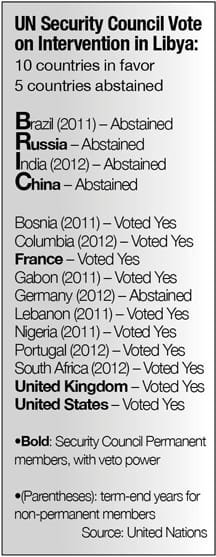
This disagreement shows that these up-and-coming countries are no longer afraid to openly disagree with the U.S. and other western powers on collective foreign policy decisions.
The BRIC countries
These four countries, which collectively make up 40 percent of the world’s population and 25 percent of the world’s landmass, are capable of forming a world economic order comparable to the current G7 that dominates global trade.
All the BRIC countries have been considered “developing” since the end of the Cold War, but with their unified acceptance of capitalism and globalization, they have seen recent spikes in population, GDP, technological advancements, mass production and services.
China alone is speculated to be equal in size to the U.S. economy by the mid-2020s and more expansive by 2050. It recently passed Japan to become the world’s second largest economy in absolute volume.
What abstention means
The reluctance of these rising powers to support the west’s drive to intervene shows they are ready to collectively stand up and oppose the way the U.S. and Europe run international politics.
It shows these four countries are not only gaining power and traction economically, but are also not afraid to flex their influence politically.
Former Brazilian president Luiz Lula da Silva condemned the military intervention, calling it “weak.”
“If we had twenty-first century representation [in the Security Council], instead of sending a plane to drop bombs, the UN would send its secretary-general to negotiate,” he said.
Still, their reluctance to vote against the resolution — or even veto it, which Russia or China could have done — shows the countries are not strong enough politically to completely oppose the West’s actions, yet.
Although the BRIC countries were unified in their abstention in the Security Council, their domestic reactions to the Libyan conflict vary.
China has been censoring and fabricating news about Libya and the rest of the Middle East protests to reduce the chances of resistance forming at home. The other BRIC countries denounced Muammar Khadafi’s military repression but believe there are better solutions than western military intervention.
“I would like to re-emphasize that India continues to be gravely concerned about deteriorating humanitarian situation in Libya,” Manjeev Singh Puri, India’s deputy envoy to the UN, said in a statement released after the vote. “We call on the Libyan authorities to cease fire, protect the civilian population and address the legitimate demands of the Libyan people.”
Adapting foreign policy
The former Brazilian president and Indian diplomat may in fact be right. The leaders of this country need to take a step back and look at alternate ways to enact policy and diplomacy abroad.
The U.S. needs to revamp its collective security measures within UN and NATO to include opinions of countries that will dominate global politics in the years to come, instead of those who have dominated it in years past.
Obama and his allies in Europe should have questioned the abstention of these rising powers and opened a discourse on alternative options, instead of defying the reluctance of governments that represent such a large portion of the world’s population.
The way the world responded to Libya is just the beginning. In 20 or 30 years the U.S. will be struggling to keep its position as the most powerful country on earth. It’s going to be a harsh reality for our leaders when we reach that point, and they need to start preparing for it now.