Student voice silenced at Academic Senate meeting
When City College Student Trustee Josh Nielsen tried to ask a question at a March 23 special meeting of the Academic Senate, he was told to “sit down” and “shut up” by members of the faculty.
By Greg ZemanThe Guardsman
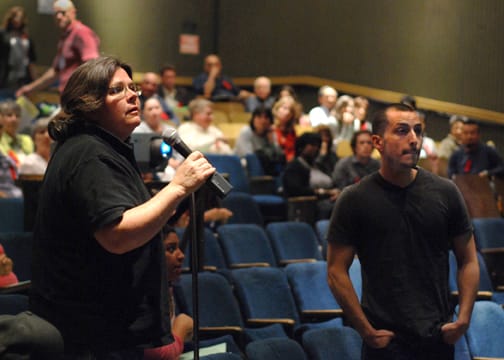
When City College Student Trustee Josh Nielsen tried to ask a question at a March 23 special meeting of the Academic Senate, he was told to “sit down” and “shut up” by members of the faculty.
“I asked just a point of process, just for clarification,” Nielsen said at a March 25 Board of Trustees meeting. “I was appalled as a student to see faculty and a lot of people that I’ve seen within the institution provide me the education, and now I’m seeing they really don’t value what students really want out of an education.”
Many faculty members, including City College music instructor Bob Davis, don’t see it that way.
“He was asked to leave the microphone and sit down more than once and would not relinquish the microphone. That’s not appropriate behavior,” Davis said. “I feel that there were some students who were inappropriate and rude, and that when you’re dealing with people who are out of order they should be treated as out of order.”
Academic Senate President Hal Huntsman, addressing the board on March 25, said he was deeply disturbed by the events at the special meeting and apologized to Nielsen and the student body for the behavior of his colleagues.
“You were literally shouted down and told to go away, and that was a low point in my personal career here,” he said.
When Nielsen refused to sit down at the March 23 special meeting, Fred Teti, the parliamentarian for the meeting called a security officer to enter the room.
Political science instructor Sue Homer, shocked by Teti’s request, advocated for Nielsen’s right to address the senate.
“I actually shouted out, ‘are you going to arrest our students? Are you calling for them to arrest our students simply for trying to speak?’ We heard, ‘go away, shut up, sit down, get out!’,” Homer said. “What kind of institution is it where educators are afraid of their own students sharing their point of view?”
Librarian Karen Saginor, who served as facilitator of the Academic Senate special meeting, said Nielsen is a member of the board which authored the resolution being considered.
“Josh himself has kind of a conflict of interest because he’s a member of the Board of Trustees,” Saginor said. “Was he speaking as a student or as a member of the board? There was some confusion there.”
Saginor said she wished she would have suggested that faculty concerned about allowing students to speak could have yielded their time to a student. In hindsight, she said a block of time could also have been allotted for students to speak at the beginning of the meeting.
Fears of disruption
“Up until the moment that the meeting began, the organizers’ intent was to completely deny student’s access to the meeting,” Homer said.
But meeting organizers and City College Police Department Chief Andre Barnes denied that allegation.
“We had heard rumors that some students were planning a disruption of the meeting, which made people nervous,” Saginor said, adding that there were seats provided for students and no effort was made to exclude them.
Barnes said his office provided only one uniformed officer for the event.
“We didn’t give any specific instructions for this meeting but to do what we normally do as a matter of course of our business,” he said. “It went uneventful, at least from our standpoint. We didn’t take any police action.”
All for equity
Darlene Alioto, chair of the social sciences department, addressed the Board of Trustees after Nielsen to “set the record straight” about the Academic Senate special meeting.
“The meeting of the Academic Senate was not a meeting to discuss the Achievement Gap and Equity Resolution, we have yet to get there, and we need to. That meeting was a governance meeting,” Alioto said.
The special meeting was called by petition to address the concerns of faculty who felt that the board recommendation authored by Trustees Chris Jackson, Milton Marks III and Steve Ngo was too prescriptive and overreaching regarding math and English sequence changes. Some senate members are concerned that the certain changes to curriculum proposed in the recommendation could negatively affect the college to the point of jeopardizing its accreditation.
All faculty interviewed said they are committed to complete equity in education and that their opposition to the nature of the board’s resolution does not in any way oppose equity.
“It wasn’t an area where we were discussing an equity resolution, where of course students would have had primacy in that discussion,” Alioto said.
Nielsen found that explanation inadequate.
“That’s ridiculous, that students don’t even have an opportunity to voice their concerns when it affects them primarily,” he said.
Francine Podenski, chair of the broadcast department, said all faculty are dedicated to equity.
“The average teacher at City College cares completely about this and will do anything they can think of to narrow the gap,” she said. “That’s why people work at City College and not Berkeley.”
Davis said the issues of governance discussed at that meeting do not concern students.
“The meeting had nothing to do with whether people support equity or not; we’re all working very hard for equality. We have been for a long time now,” Davis said, adding that the board’s resolution did not present a new approach to the achievement gap.
“We’ve been trying to solve these problems with race-only and ethnicity-only solutions since the 70s and it doesn’t work,” he said.
Davis added that the equity report the board relied on in part to write the resolution did not address the academic performance of the LGBT community, women, veterans, non-native English speakers and other groups that “cut across racial and ethnic lines.”
Trustee Chris Jackson said he wants to see real progress on closing the equity gap.
“I understand their concerns about it being too narrow and specific. We can go back and forth, but that doesn’t really help the students,” Jackson said. “We’re not going to dictate. We’re going to ask the English and math departments to come up with specific requirements to attack the achievement gap specifically relating to issues of sequencing and Pass-No/Pass.”
Accreditation concerns
Some faculty members, including Davis, feel that City College’s accreditation could be jeopardized by an over-extension of the board’s authority.
“By state regulation and by the education code there are certain responsibilities for the administration, the board and the faculty, and this administration inadvertently entered into areas that are the purview of the faculty without consulting with the faculty,” Davis said. “Their enthusiasm to do the right thing clouded their judgement.”
California Education Code Sec. 53200 outlines 10 specific responsibilities that are reserved for the Academic Senate. This list of faculty responsibilities is called “ten plus one” because there are ten responsibilities plus an eleventh item reserving the right to take responsibility for other matters “mutually agreed upon” by shared governance.
Homer said that while there are some legitimate concerns being voiced, others are overblown.
“The irrational fears of loss of accreditation and the board taking over are just hype and fear-mongering by people with a political agenda,” Homer said. “I would classify it as a mob mentality that was completely irrational and not in the best interest of students.”
Huntsman said he was approached by organizers of the Academic Senate special meeting and asked how a petition containing at least 100 senate member signatures could be validated in order to call the meeting, and he told them he and other senate officers should verify the signatures. But he was told the signatures would not be shown to him or be made public.
“I expressed to them that I thought that called the validity of their meeting into question,” Huntsman said. “However, I in no way wanted to stand in the way of that dialogue because I thought it was important.”
Jackson said the resolution does not violate any union contracts or education codes and wants to reassure teachers that the board is not trying to tell them how to teach, but he wants to see real action.
“I’m tired of arguing about the process, and I think the students in underserved communities are tired of arguing about the process,” Jackson said. “The status quo is not good enough for San Francisco. The status quo is not good enough for City College.”