California’s broken juvenile justice system: Proposal to cut state’s system brings up ghosts of youth torture
Gov. Jerry Brown’s January proposal to eliminate the Division of Juvenile Justice was one way of grappling with the state’s more than $25 billion budget shortfall, hoping counties could gradually absorb all youth prisoners leaving the state’s system.
By Tony LeTigre
The Guardsman
Gov. Jerry Brown’s January proposal to eliminate the Division of Juvenile Justice was one way of grappling with the state’s more than $25 billion budget shortfall, hoping counties could gradually absorb all youth prisoners leaving the state’s system.
But many juvenile justice experts see deeper moral issues than decaying property or saving money.
“I testified to the state legislature on closing the CYA in 1988,” said Daniel Macallair, executive director of the Center on Juvenile and Criminal Justice, a nonprofit based in San Francisco. “They’re a system that’s been under fire for more than the 25 years I’ve been around, with steady reports of abuse and scandal.”
Macallair described the juvenile prison system as an institutional failure, based on the Victorian era reform school model of isolating “bad seeds” from their homes and families and from the corrupting influence of urban vice.
“I agree with the direction the governor is taking, as long as the state will provide us the resources,” said William Siffermann, San Francisco Juvenile Probation Department’s chief probation officer. “While I recognize the state will still need a secure placement for juveniles convicted of serious felonies, I believe it could be administered locally with evidence-based practices that are more therapeutic.”
Brown’s initial proposal to cut the DJJ became embroiled in controversy, and by the end of February he backtracked, stopping short of completely dissolving the DJJ in a revised budget that allows counties the option to continue sending their juvenile offenders to state correctional institutions.
Bill Sessa, a spokesman for the DJJ, said the division doesn’t accept most juvenile offenders anyway.
“The youth we have are those who commit the most serious violent felonies and the sex offenders, and they have already exhausted the treatment available at the county level,” Sessa said.
Less than human
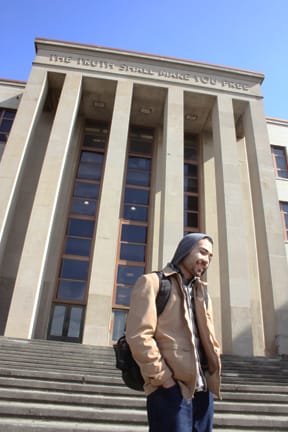
Joaquin DiazDeLeon, now 21 and a City College student, spent two years in the California Youth Authority, which is now the DJJ. He said he experienced corruption, violence and gross maltreatment there that left him both figuratively and literally scarred.
DiazDeLeon arrived at the Preston Youth Facility in Ione, Calif. in 2006, after a stint in a juvenile hall in Fresno.
“It’s a demonic place,” DiazDeLeon said of Preston. “All the youth were traumatized, brainwashed, cursing at each other. The guards dehumanized you by making you feel you were a monster and deserved inhuman torture.”
Sessa played down the more disturbing details of accounts by DiazDeLeon and other former DJJ wards.
“While I have no first-hand knowledge of this young man’s time in DJJ, I would be somewhat skeptical of the allegations,” Sessa said. “What I do know for sure is there is no way the sort of behavior he describes could be going on now.”
The California Department of Corrections and Rehabilitation confirmed that Preston will close permanently this June, leaving just four DJJ prisons and two firecamps in the state. The current total DJJ inmate population is about 1,200, having dropped steeply from 10,000 in 1995.
Official reasons for closing Preston were the property’s dilapidated condition, as well as the steady decline in the state’s youth prison population over the last 15 years. The CDCR neglected to mention that facility’s disturbing history of reported abuse.
Prep school for prison
The state juvenile prison facilities made no serious effort at rehabilitation, but instead promoted an ongoing culture of incarceration, former DJJ inmate Carlos Esqueda said. He spent from 2004 to 2007 in California’s juvenile justice system, serving some time at Preston — which he described as “a little gladiator school” — and some time at the O.H. Close Youth Correctional Facility in Stockton.
“I saw one-on-one fights, people trying to stab somebody,” Esqueda said. “I was involved in three riots and 10 fights during a single month in Preston. Every morning I was waking up ready to fight, ready for action.”
Esqueda and DiazDeLeon both formed or joined gangs in DJJ as a matter of survival.
“I saw staff allowing and coordinating violence, drug trafficking and drug use, staff sexually involved with youth, cruel and unusual punishment,” DiazDeLeon said. “Punishment was to be put in lockup for close to 24 hours. They would put you in cages like a rooster, a human-sized box, and the guards left the doors open so people could run in and attack you in this cage.”
Esqueda said the corruption of correctional officers in the DJJ was just as it is known to be in an adult prison. Claims against guards for abuse and neglect were not taken seriously and could lead to violent retaliation. He described a time when guards were called to restrain him after a fight. He was dragged off his bed, punched and kicked, slammed into the bed’s metal frame and put in handcuffs.
DiazDeLeon, who was at Preston at the same time, witnessed the melee. When DiazDeLeon, Esqueda and two others threatened to report the abuse, the guards locked them all together in a room with a tear gas bomb, in front of a fan that circulated the tear gas directly into their faces, DiazDeLeon said.
“They told us ‘You can go ahead and snitch, but you’re not gonna win,’” Esqueda said. “They said, ‘There’s a lesson to be learned here, and you better suck it up.’”
The Farrell v. Cate lawsuit, initiated in 2003 and settled in 2005, generated a great deal of documentation of the abuses faced by wards of the CYA, with national experts using California’s juvenile justice program as an example of a broken system. This led to court intervention, a major overhaul of the CYA and its conversion to DJJ.
“Since 2004, DJJ has been under court order with six remedial plans overseen by the Superior Court of Alameda, one of which is specific to the safety and welfare of youth,” Sessa said. “Auditors are allowed inside our facilities constantly, and the courts are looking over our shoulder at least four times a year to make sure we are in compliance with every part of the plan.”
But he acknowledged that DJJ didn’t even receive its first funding until 2007 – when Esqueda was already out and DiazDeLeon had one year remaining.
PART II
While the Preston Correctional Youth Facility near Ion, Calif. will close permanently in June, Gov. Jerry Brown stopped short of completely dissolving the Department of Juvenile Justice in a revised budget, which allows counties the option to continue sending their juvenile offenders to state facilities.
Dan Macallair, executive director of the Center on Juvenile and Criminal Justice, sees Brown’s backpedaling on the DJJ issue as a necessary compromise that won’t substantially alter the direction of things.
“I am pleased with the governor’s proposal from the standpoint that it is a long-overdue initiative,” he said.
But with the DJJ in danger of being sent permanently to lockup, voices of protest have come from all sides. Many juvenile justice officials – such as Karen Pank, executive director of the Chief Probation Officers of California in Sacramento – as well as the state probation department, victims’ rights campaigns and police unions have spoken against the closure.
In late February, at the same time Gov. Brown moderated his initial proposal, CPOC posted an open letter to the governor that warned of the possible outcomes of eliminating DJJ. Instead it urged him to utilize “the successful model currently in place, Penal Code 1230(b) – the Community Corrections Partnership.”
The letter ended with an ultimatum that CPOC would only support a revised proposal in which the state maintains a role in the juvenile justice system allowing probation to utilize DJJ without fiscal penalty.
The California Correctional Peace Officers Association, the union presenting corrections officers, is also opposed to the DJJ shutdown. But Macallair said, “These people aren’t going to lose their jobs. They will be absorbed into the department of corrections, and there are positions available. There are 3,000 openings statewide for guards right now.”
Bill Sessa, a spokesman for the DJJ, said that Farrell v. Tilton, a taxpayer lawsuit alleging that the DJJ fails to provide adequate care and services to juvenile offenders housed in DJJ facilities, along with two pieces of legislation from 2007 – Senate Bill 81 and Assembly Bill 191 – gave counties the incentive to house their criminal offenders. He said what remains of DJJ is a necessary reservoir for juvenile criminals the counties are not equipped to handle.
Progressive critics want to address the underlying social issues that lead youth into the justice system in the first place. They say education (or lack thereof), as well as racial issues are often ignored or avoided.
In a 2006 report, the Public Policy Institute of California found that adult black men are seven times as likely as white men and 4.5 times as likely as Hispanic men to be incarcerated. Data from 2010, compiled by the institute, found that during the previous fiscal year the state spent more than $200,000 per juvenile in DJJ compared to $7,500 per K-12 student.
Joe Brooks, vice president of civic engagement at the Oakland branch of PolicyLink, a national social equity institute, opposes the elimination of DJJ. He doesn’t believe many counties will have the financial resources to offer better rehabilitation than currently found in the state system.
“One size does not fit all when it comes to counties,” Brooks said. “And if a county doesn’t have the capacity or the will to care for kids, they could be blended into the adult prison system, and then we’ll be one step forward and two steps back.”
“We are going to have to work hard to change behavior in the counties so they have good systems and won’t need to send kids to adult criminal court, ” Macallair said.
Rehabilitation over incarceration
For those who consider DJJ an outdated and ineffective system, the brightest hope for change may be the Missouri Model. This nationally recognized corrections model seeks to rehabilitate juvenile convicts into functional members of society rather than treating them as incurable criminals. It has a track record of proven effectiveness and consistently low recidivism rates and has been adopted by other states and municipalities, including Illinois, Louisiana, New Mexico, Washington, D.C. – and California.
“The way you design facilities dictates staff attitude and behavior of kids,” Macallair said. “The Missouri Model is in direct contrast to the institutional care that kids get now. It’s based on designing facilities that are smaller, more homelike, rejecting the prison design, developing positive relations with staff.”
William Siffermann, chief probation officer with the San Francisco Juvenile Probation Department, said the impact of the statewide adult realignment upon San Francisco county juvenile probation has been minimal since the county declared a moratorium on DJJ commitments in 2004.
“We only have five kids in state facilities,” he said. “There are other counties with lower populations who send many more kids into DJJ and they’re attempting to deal effectively with the potential impact of realignment.”
The Missouri Model is now being implemented at Log Cabin Ranch School, a county juvenile justice facility in a remote setting 50 miles from San Francisco. Siffermann sees the ranch as the first out-of-home dispositional placement alternative.
This hasn’t always been the case. In the past it was considered the last stop before juvenile offenders entered the state system. Other counties such as Santa Clara, Santa Cruz and San Jose have also adopted or are considering the model’s therapeutic and rehabilitative methods.
Sessa said the reforms to DJJ resulting from the Farrell lawsuit are largely based on the Missouri Model under the guidance of subject experts appointed by the Alameda court.
“It is not a literal copy of the Missouri Model,” he said, “but what it has in common is intense, very specialized treatment, small living units rather than dormitory style housing and a high ratio of staff to youth.”
Back to the future
Joaquin DiazDeLeon turned to spirituality and faith as a way to get through his nightmarish experience at Preston Youth Facility. “Towards the end I secluded myself, purged myself from everything around me,” he said. “I started to go crazy, and I asked God to do the impossible.”
He was released on parole in 2008 and moved to San Francisco a year later. After enrolling at City College, he became involved with Books Not Bars, an Oakland-based nonprofit that educates prisoners about their rights.
Carlos Esqueda was released from DJJ in 2007. The former gang member, 22, now lives in Fresno with his girlfriend and daughter.
“This March was my four-year anniversary of being out, with no crimes, no arrests,” he said.
Of facilities in California that have adopted the Missouri Model, Esqueda said, “I’ve heard it’s a comforting setting, with couches in the day room, counselors, that it’s not as violent. It sounds like people get the care they need, and they are not just thrown away and forgotten.”
Sessa stressed the dramatic changes DJJ has gone through over the last five years, supported by court reports available to the public on the department’s website. Last year’s report found DJJ in compliance with 85 percent of the reforms, while making significant progress with the remaining 15 percent. Sessa said DJJ inmates today start with an extensive assessment by an entire team of staff. A high school diploma or GED education is a basic condition for parole. The greatly improved rehabilitation services, he said, are the reason for the astronomical cost to the state – about $230,000 annually per youth.
DiazDeLeon, however, fears that in all of improvements being made in juvenile care, the ghosts of Preston might slip through the cracks of history.
“The real question in the minds of us all should be, ‘Where is the justice in our justice system?’” said DiazDeLeon. “DJJ has violated prison protocol, extorted tax payers, and hid corruption from the public for over 40 years. Money is being used as a scapegoat. What about people? You be the judge.”