Euphemisms turn into reality as PCRF heals
The United States are currently involved in two official wars: Afghanistan and Iraq - and we have helped to completely destroy these countries.
By Robert RomanoThe Guardsman
The United States are currently involved in two official wars: Afghanistan and Iraq - and we have helped to completely destroy these countries.
We wag a finger at the Iranian government about human rights abuses and fear it may have nuclear weapons. At the same time, we turn a blind eye to Israel — an undeclared nuclear state — as its government commits systematic genocide against the Palestinian people.
In the U.S. we have department of Homeland Security to protect us. Why can’t our administration protect the innocent victims of our collateral damage?
We should have a department of collateral damages that is funded by the government and run by civilians. Right now, these victims of our wars have to rely on independent organizations to clean up our mess.
One such organization is the Palestine Children’s Relief Fund, a U.S. nonprofit organization that helps victims of conflict by identifying children in medical need and arranging free care for them in countries with the necessary infrastructure.
Berkeley resident Rana Tomaira began assisting the PCRF when she traveled with her family to Jordan. After receiving an e-mail asking for help, she obtained a visa for an Iraqi boy attempting to enter the U.S through Jordan. Post-9/11 law requires two visas for such travels — one to enter Jordan through Iraq and another one to enter the United States.
Tomaira has established a system that continues to facilitate visas via email and fax, which she started with the help of the Civil Affairs Liaison Team in Jordan, a branch of the military set up as an intermediary between U.S. armed forces and civilians.
The CALT office in Jordan, however, was only opened as a public relations stunt, and it was promptly closed when the Bush administration became uninterested in the public’s opinion about the war.
The Obama administration seems to feel the same way when it comes to public opinion about conflict with Afghanistan.
Tomaira managed to rescue seven children and got them the medical attention they needed. She acted as a visa-facilitator, translator, shuttle driver and took care of the children’s basic needs.
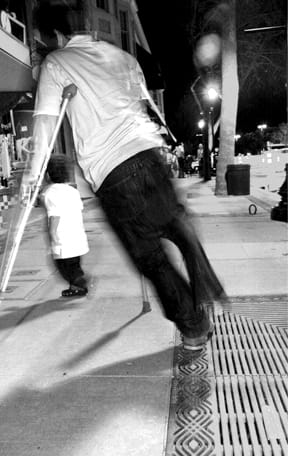
Her family also hosted PCRF-sponsored Ahmed Ali Hani, now 16, from Sept. — Nov. 2008. He had lost his leg in a Baghdad suicide bombing that killed his father and 300 others.
When he came to the United States, Al Hani was outfitted with an prosthetic leg by Tony le France and a team of orthopedists and prosthetic specialists at Laurence Orthopedic. All costs, including the $16,000 procedure, were covered by donations.
The American government should be required to provide medical assistance to non-combatants. A first step would be to stop using the euphemism collateral damage to lessen our degree of responsibility.
“Is it not our duty as humans to help our blood children be healthy, positive loving adults? And our duty as humans to help all children wherever they may be in the world?” said Nuha Shuman, a former PCRF host-mother. “For now, thankfully, we rely on those in the PCRF and other organizations to quietly assume the burden of the world’s wars.”
We are told that civilian death is unfortunate, but collateral damage is the price we pay for freedom. Part of paying the price is taking responsibility and helping innocent victims of war.
Besides, the word collateral damage is a euphemism that dehumanizes and makes people easier to kill.
One surefire way to protect children is not to go to war in the first place.