Equity Talks Challenges Myths of Self-Reliance
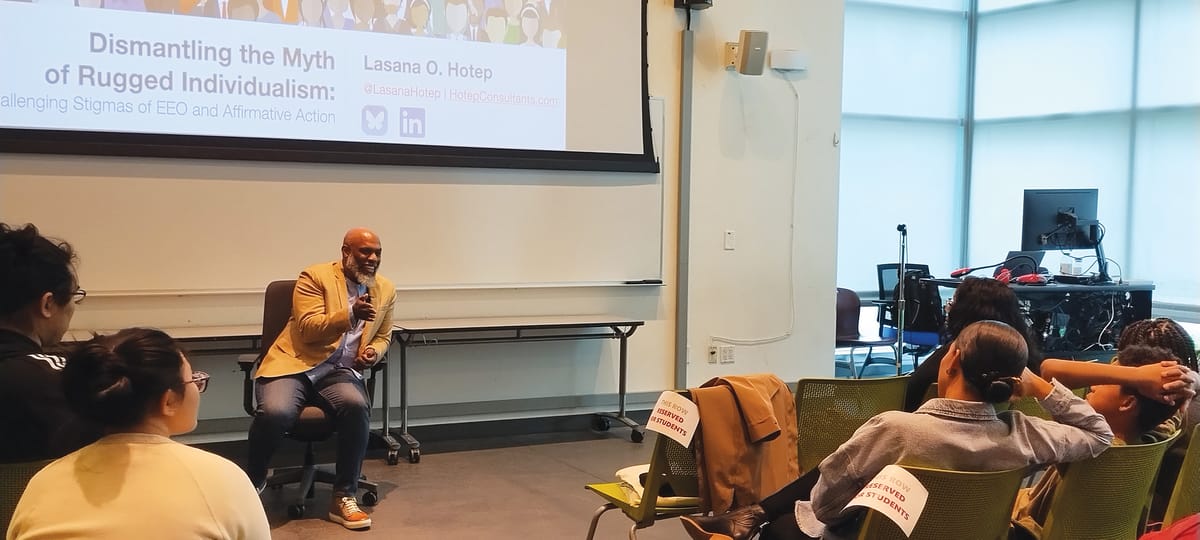
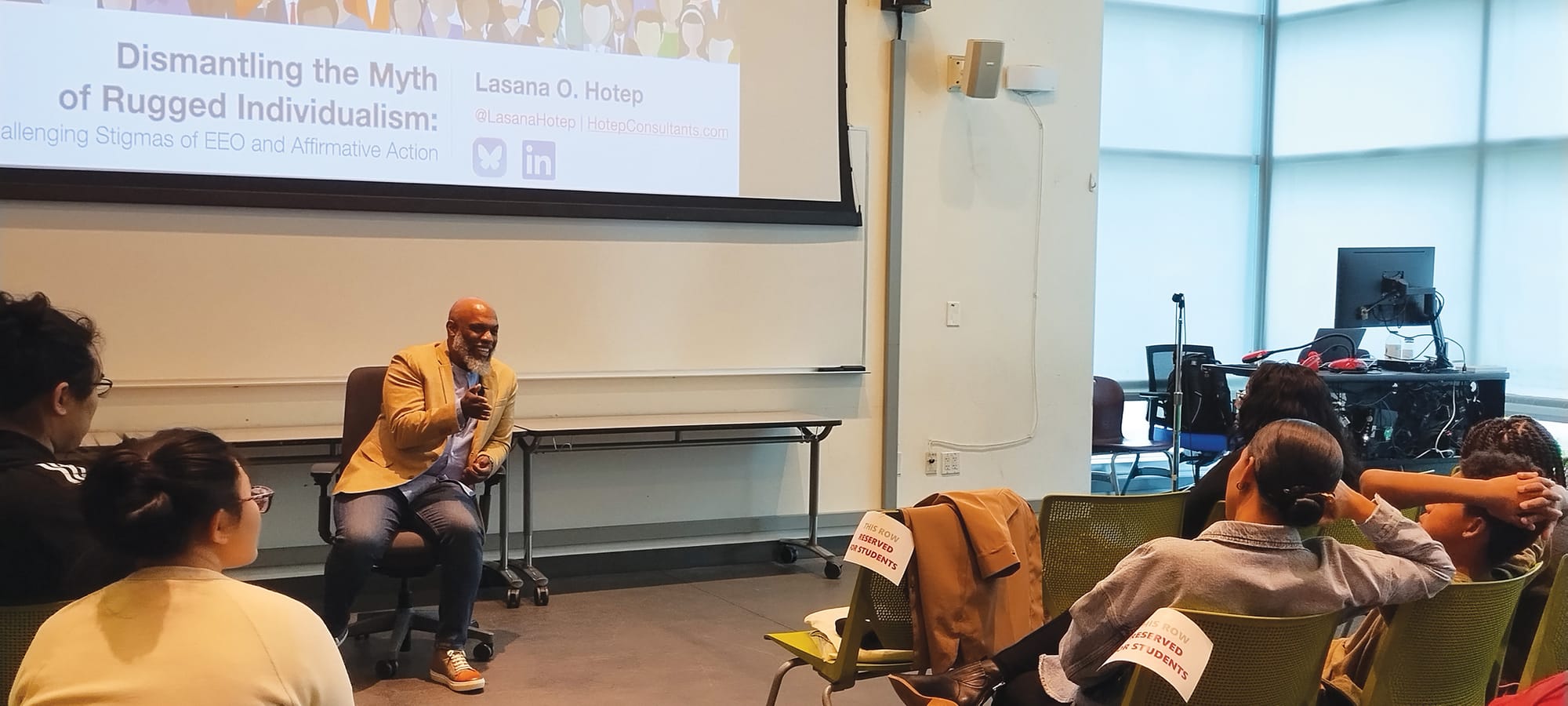
Lasana O. Hotep delivered a powerful presentation titled “Dismantling the Myth of Rugged Individualism: Challenging Stigmas of Equal Employment Opportunity and Affirmative Action.” The presentation, which took place on March 12, was the second part of the Equity Talks Speaker Series.
By Qi Maiqmai10@mail.ccsf.edu
Lasana O. Hotep delivered a powerful presentation titled “Dismantling the Myth of Rugged Individualism: Challenging Stigmas of Equal Employment Opportunity and Affirmative Action.” The presentation, which took place on March 12, was the second part of the Equity Talks Speaker Series.
Hotep is “an educator and entrepreneur committed to developing strategic and practical solutions to address systematic inequities in educational, corporate and community organizations.”
In his presentation, he critiqued the myth of rugged individualism: the idea of self-reliance, pulling oneself up by the bootstraps and overcoming seemingly insurmountable odds. While these stories often highlight personal resilience, Hotep emphasized that they also contribute to stigmas surrounding efforts to address historical inequalities. These stigmas, he explained, are designed to evoke feelings of shame, hopelessness and isolation, ultimately reinforcing the status quo and maintaining institutional power.
Hotep centered his discussion on the persistence of racism and discrimination despite legislative milestones such as the Civil Rights Act of 1964 and the Voting Rights Act of 1965. He stressed the ongoing need for affirmative action and EEO measures to combat structural racism. He examines cases of children's prejudice in income, housing appraisal bias, the “name game” in employment and disparities in education.
A striking moment in his talk came when Hotep used a pop culture analogy to highlight America’s selective memory regarding racism. Referring to the movie “50 First Dates,” he compared the heroine’s short-term memory loss to America's tendency to repeatedly forget its history of racial injustice.
“Every time they go out, it’s like the first time because she has short-term memory loss or a sense of amnesia,” he said. “That's kind of how America is when it comes to racism. We keep going on this date again and again.”
During the Q&A session, one student asked Hotep what inspired him to pursue his work. Hotep shared his roots, growing up in Los Angeles in a loving family with financial stability but always wondering why the African American experience portrayed on television looked so different. He explained that these disparities weren’t just about individuals or families—they were about the structure of society. This realization drove him to become a professor, helping others understand systemic inequality.
“Don’t make the black experience as a black person. Hope fostering relationships destroy some racism.” He called for a more effective approach to addressing racial inequities and breaking down systemic barriers.
This discussion marks the second part of the Equity Talks speaker series, organized by the Office of Student Equity and the Equal Employment Opportunity Advisory Committee. In Part one, Hotep’s topic, “Greater Than the Sum of Our Parts: Institutionalizing Belonging at the College,” set the stage for these important discussions.
The series will conclude with the third presentation, “Culture Eats PD for Breakfast: Culture Change vs. Risk Management,” scheduled for April 16 at 10 a.m. in Harry Britt 140.