CCSF and State Officials Block Over 25,000 Fraudulent Enrollments in Financial Aid Crackdown
CCSF halts 25,000+ fraudulent enrollments with AI and state partnerships, reducing faculty burden and safeguarding class access for genuine students amid rising financial aid fraud.
By Qi Mai
The Guardsman recently ran a three-part investigation into a growing crisis at City College: the alarming rise of ghost students — fraudulent enrollees who exploit the college system for financial aid. From hackers manipulating enrollment systems to real students struggling to prove their identification, the story of City College’s battle against financial aid fraud is one that continues to evolve.
25,000+ Fraudulent Applications Stopped
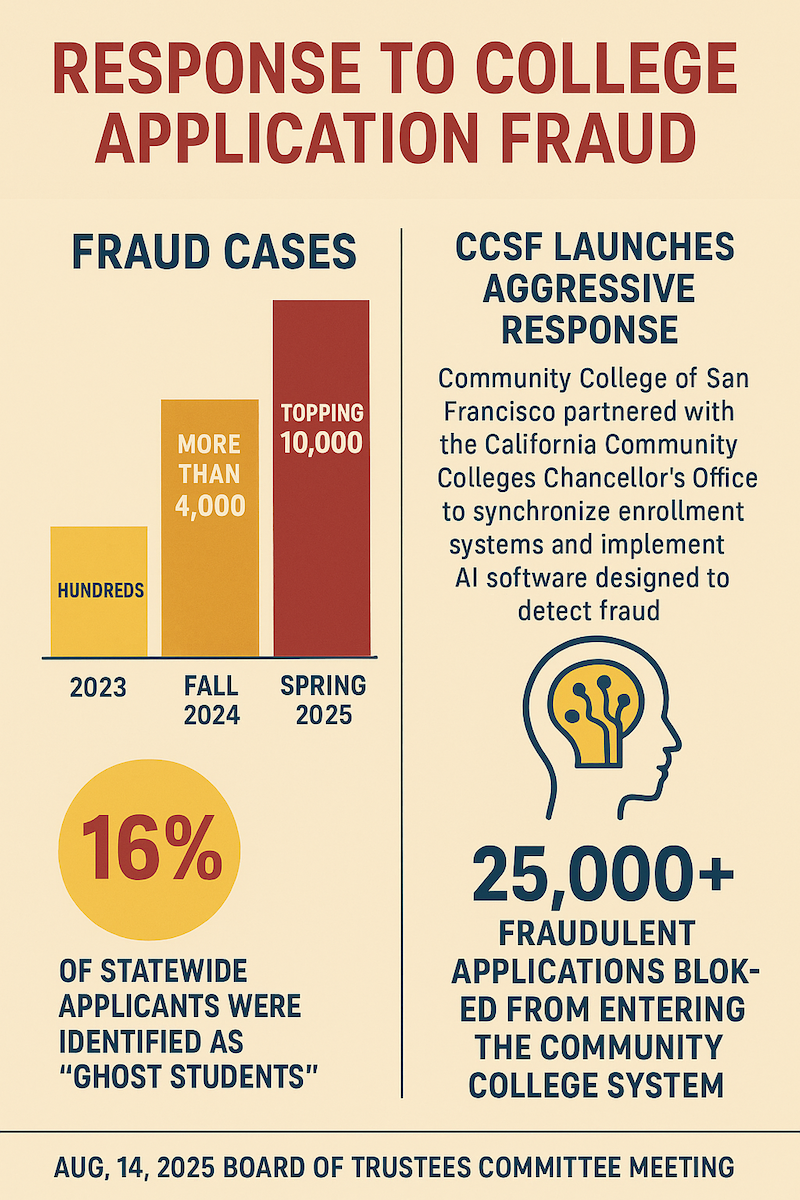
According to The Guardsman’s investigation, fraud cases rose dramatically from a few hundred in 2023 to more than 4,000 in Fall 2024, and topped 10,000 by Spring 2025. The fraud’s scale was staggering and resulted in statewide losses of millions of dollars.
Reports from the San Francisco Chronicle and the Associated Press confirmed that 2024 saw a statewide surge in financial aid fraud: 1.2 million fraudulent applications and 223,000 fake enrollments. At least $11.1 million was lost in unrecoverable financial aid. These figures place total financial damage in the low tens of millions, with 2024 described as a “surge year” for bad actors targeting California’s higher education system.
Beginning in late 2024, City College partnered with the California Community Colleges Chancellor’s Office to share information and implement artificial intelligence software designed to detect fraud.
The new system is already showing results. At the Aug. 14, 2025, Board of Trustees meeting, officials reported that in July alone, about 16% of statewide applicants were identified as “ghost students.” In just two months, more than 25,000 fraudulent applications were blocked from entering the community college system.
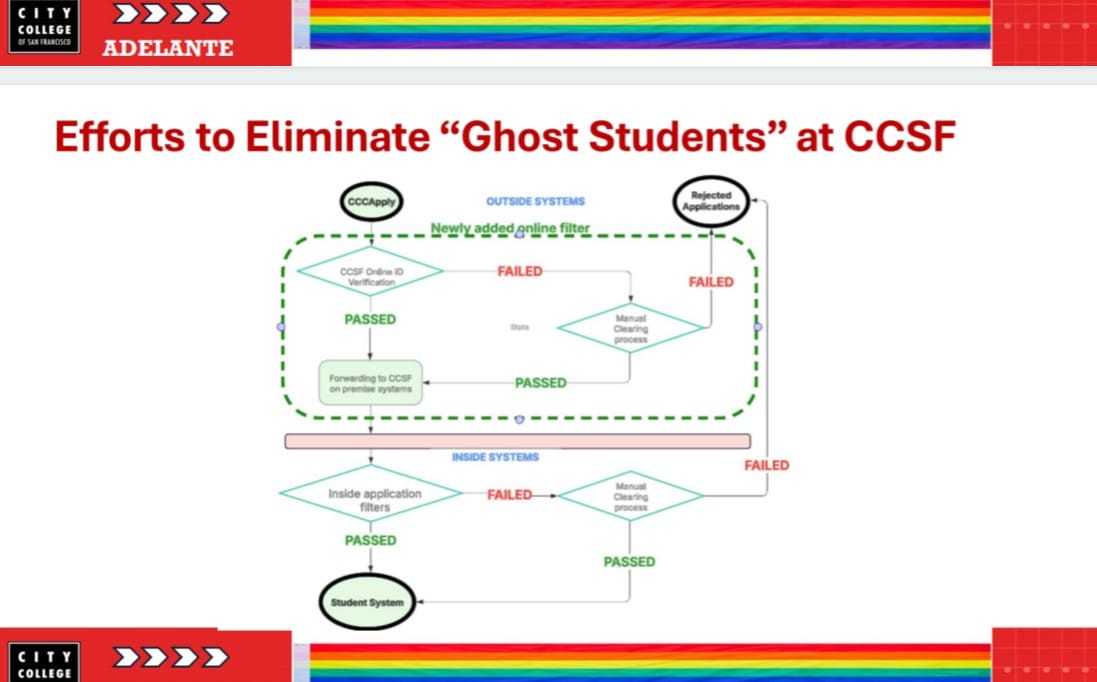
Multiple Safeguards Against Ghost Students
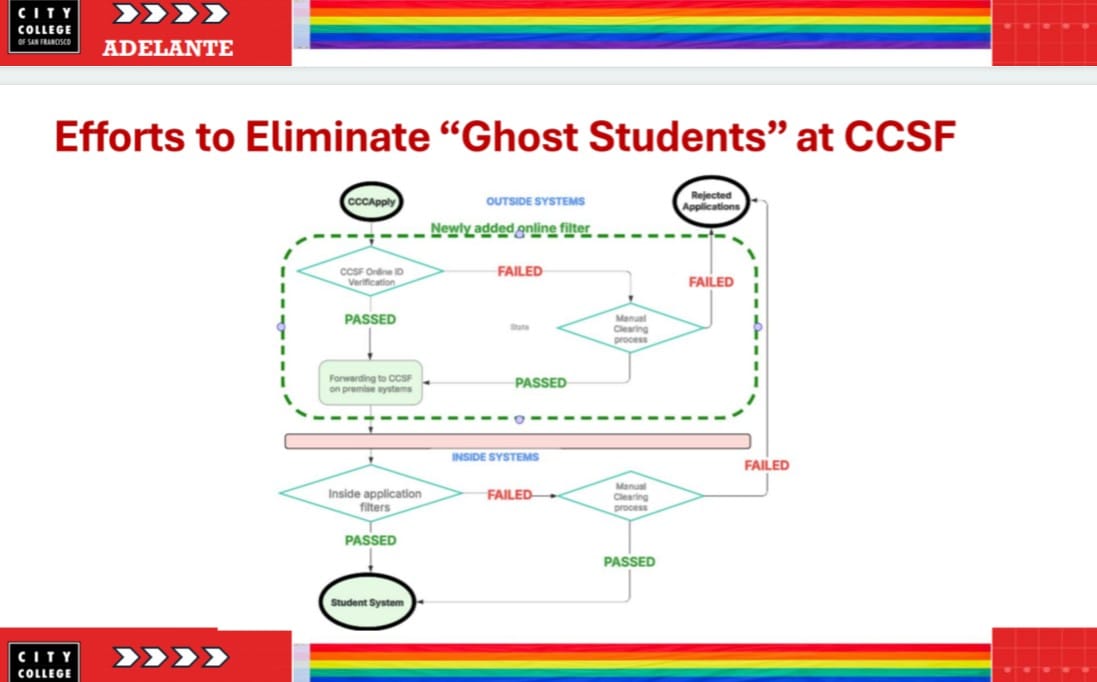
COCA’s newly added online filters have shown mixed results, with some failing to stop fraudulent applications while others successfully block them. Similarly, City College’s internal safeguards, ranging from application reviews to in-house fraud filters, have produced both failures and successes. Together, these combined measures show how state-level and college-level protections are steadily strengthening the fight against fraudulent enrollments.
As part of the crackdown, ghost students were denied access to official City College email accounts and systems. More importantly, improvements in institutional filtering dropped the false positive rate — legitimate students wrongly flagged as ghosts — from 3% to just 1%. The college continues to monitor and update these systems to stay ahead of scammers’ evolving tactics.
Faculty Burnout and Class Disruptions
Faculty members at City College have borne the brunt of the ghost student crisis. Some reported spending 40 to 60 extra hours during spring to verify enrollment and remove fake students from their rosters. In extreme cases, courses were canceled when class sizes dropped too low after purging ghost enrollments.
Dr. Frederick Teti, Interim Dean of the School of STEM and the Evans Campus, acknowledged the toll but praised the behind-the-scenes effort.
“There were countless complaints from instructors last year about ghost students. Now, while there are still grumblings, they are vastly reduced,” he said.
Teti credited staff from the Admissions and Records Department, particularly Associate Registrar Wil Wu, for their “heroic work” combating fraud, and applauded the adoption of a new three-day registration grace period, reduced from seven days on the recommendation of the Technology Committee. The shorter window, Teti noted, limits the time fraudulent accounts can exploit the system while still giving legitimate students sufficient time to finalize enrollment.
Some prerequisite courses have been relatively safe from fraudulent activity, such as CS 270, taught by Computer Science Department Chair Jonathan Potter. However, Potter strongly suspects that ghost students have caused the department to lose real students in recent semesters. He received reports from instructors about students who never showed up or submitted only AI-generated work. “This became a major distraction for the department,” Potter said.
For the first week of fall 2025, Joseph Reyes, chair of the Biology Department, was happy to inform The Guardsman, “Right now everything is full, everything is fine. But the spring semester was a disaster. BIO 130, a Nutrition and Culinary Arts course, had 70 students enrolled and many more on the waitlist. After the first week of class, we had to remove 30 ghost students.”
Real Students Pay the Price
Beyond the administrative burden, the impact of ghost students has been deeply felt by legitimate students.
Daniel Kelly, a second-year business administration major at CCSF, said the fraud crisis has directly disrupted his education. “Last spring, I was forced onto waitlists and even started one of my courses two weeks late,” he said. “I caught up, but I shouldn’t have had to go through that. It made it more difficult than it needed to be.”
Kelly believes many ghost students are only enrolling to collect financial aid. “It’s not fair. It’s not right. It should be criminal,” Kelly said.
As a result of anti-fraud measures, Kelly’s Pell Grant disbursement was broken into four smaller payments per semester instead of two larger ones. While he supports the effort to fight fraud, the change created financial strain. “I depend on that money for my bills. It puts a lot of strain on my budget,” he said.
Despite these challenges, Kelly has depended on CCSF support programs like EOPS for early registration, textbook assistance, and transportation. He considers himself lucky, but worries others may not have the same access. “There’s a huge demand for ESL and science classes like chemistry,” he noted. “If ghost students are taking those spots, it hurts everyone.”
Kelly, who returned to school after a shoulder injury ended his 20-year career as a commercial fisherman. “I have enrolled early, got on the waitlist and kept pursuing my goals,” he said. “Communicate with your professors — that’s how I got into a class last year, even with a long waitlist. You can’t give up.”
Keeping Watch
While City College has made progress, officials acknowledge the fight is far from over. Fraud keeps evolving, so protecting the system’s integrity takes constant vigilance. Still, the recent results offer hope that stronger collaboration and smarter technology can help reclaim the classroom — for the students who truly belong there.