A new aztec year in the mission
The Mexika new year has been celebrated at City College’s Mission campus annually since 2008, but due to a lack of funding this year[...]
Sara Bloomberg
The Guardsman
The Mexika (meh-SHEE-ka), or Aztec, new year has been celebrated at City College’s Mission campus annually since 2008, but due to a lack of funding this year the ceremony was in danger of not taking place at all.
So a group of passionate students decided to make it happen themselves.
Members of the Toltekayotl club, a loose group of about 10-15 active members, around half of whom are current City College students, said they would hold fundraisers to produce the $1000 that the college requested from them to hold the event on a Sunday, when the campus is normally closed.
The club’s mission is to provide a space for people to share their reverence for, and knowledge of, the Aztec calendar.
“By using it in our daily lives, we can create harmony in the world around us,” said Xochitl Moreno, a former student and a member of the Toltekayotl club.
According to Moreno the college has agreed to give them a month after the event to pay the fees. This allowed the celebration to proceed as planned on March 11.
It was a cold, 50-something-degree day in the city as around 50 people, from infants to elders, filled the courtyard at the Mission campus to listen to singing, spoken word and speeches performed in English, Spanish and Nahuatl, the Aztec language.
Maestro Rafael Jesús González, a retired creative writing and literature professor from Laney College, gave a blessing to the crowd in Spanish.
Another community elder, Mazatzin, explained to the crowd the significance and symbolism of the Aztec calendar.
The calendar goes through four cycles of 13 years, he explained, making one complete cycle every 52 years. This is the year of the flint, or tekpatl, which was to begin at sundown on March 11.
Xe Acosta, a member of the Toltekoyotl club, explained the symbolism of the flint.
“It represents the tongue, the word,” he said. “So, this year we gotta take an extra breath before we speak, to think about what we say.”
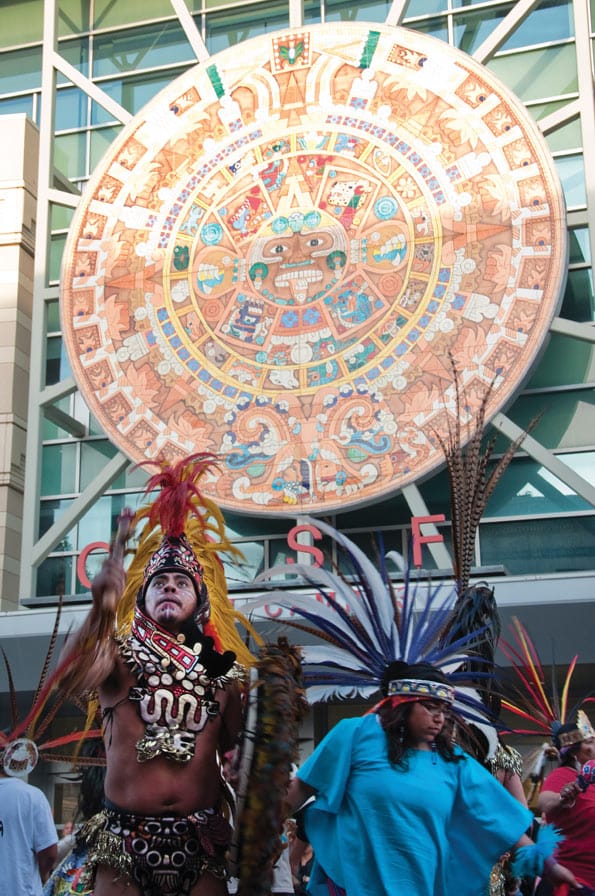
The celebration moved into the middle of Valencia Street around 6 p.m. and continued under the watchful gaze of the large, colorful tile representation of the Aztec calendar that resides on the façade of the main entrance to the campus.
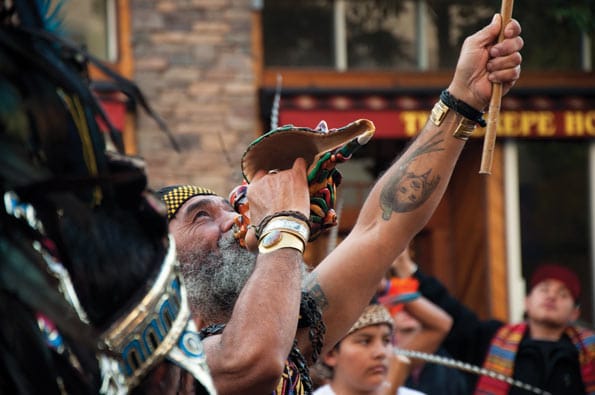
Around two dozen danzantes, or dancers, in colorful ceremonial attire entered the street and prepared for the new year ceremony. Many wore headdresses flowing with large plumes. Four drummers accompanied them with huehuetl, or traditional drums.
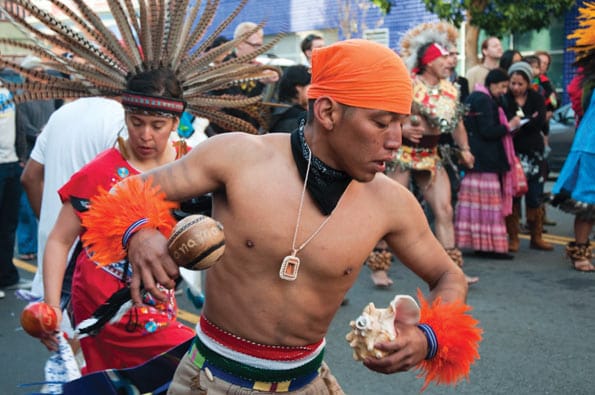
Surrounded by a circle of nearly 100 people, Mazatzin led the entire group of dancers and onlookers in a ritual to give honor in six directions.
“We’re gonna all turn together to the four corners of the universe,” Mazatzin said. He began with the north and proceeded counterclockwise until all four directions were honored. He then asked everyone to raise their hands up to the sky, the Father Sun, and then to touch the ground, to give respect to the Mother Earth.
“For a few minutes, we acted like one person, one mind, one heart,” Mazatzin said after the collective action. “Happy new year.”
For a time the air in that small section of Valencia Street was filled with the smell of incense and the sounds of drums, conch shells, flutes, rattles and chanting, until the sun finally set, marking the end of the old year and the beginning of the new one.