Alleged Wikileaker’s appalling treatment continues
The military’s treatment of alleged Wikileaker Pfc. Bradley Manning is shameful and inconsistent with the values enshrined in the U.S. Constitution.
`
By Atticus Morris
The Guardsman
The military’s treatment of alleged Wikileaker Pfc. Bradley Manning is shameful and inconsistent with the values enshrined in the U.S. Constitution.
Manning, an American citizen, has been imprisoned without trial for the last 11 months under unnecessarily harsh conditions.
An introvert who played saxophone and aspired from a young age to serve his country, Manning suffered a crisis of conscience when he was ordered by a commanding officer to ignore well-reasoned critique of Iraqi government corruption because the critics were “the bad guys.”
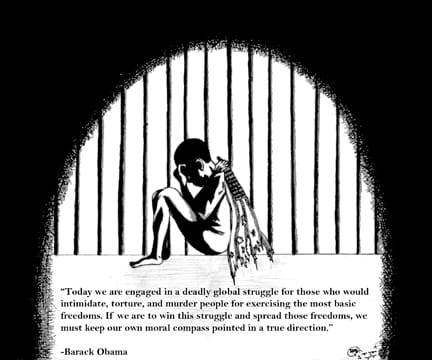
He’s been held for eight months at the Marine Corps base in Quantico, Va under “maximum custody,” which means he’s locked down for 23 hours a day and must be shackled and accompanied by at least two guards whenever he leaves his cell.
While Pentagon spokesman Lt. Brian Villiard insisted Manning’s treatment is in accordance with his maximum custody status, he neglected to mention that Manning is the only detainee being held in max custody.
This is a non-violent “offender” who has not been convicted of any crime. By Pentagon Press Secretary Geoff Morrell’s own admission, Manning is an “exemplary” detainee, so why is he being treated this way?
Many, such as CBS Radio News chief legal analyst Andrew Cohen, have suggested the military is using Manning to send a message to would-be whistle-blowers.
Whatever the rationale, it’s a direct violation of Defense Department policy, which states “no persons, while being held for trial may be subjected to punishment or penalty other than arrest or confinement, nor shall the arrest or confinement imposed upon them be any more rigorous than the circumstances require.”
David Coombs, Manning’s attorney, said the degrading treatment of his client is inexcusable and an embarrassment to the military justice system and should not be tolerated.
In addition to being held in max custody, Manning is also the only inmate under a “prevention of injury” watch. He is required to reassure his captors every five minutes that he is okay, and when he goes to sleep he is required to strip down and is denied pillow and sheets. He is also denied the use of his glasses, which leaves him to sit in “essential blindness.”
Manning’s request to be removed from prevention of injury watch was denied on March 1, despite the fact that brig forensic psychiatrists have repeatedly concluded there is no mental health justification for such watch.
The notion that this treatment is somehow for Manning’s own safety is patently ludicrous. Former State Department Assistant Secretary for Public Affairs P.J. Crowley said as much, calling it “ridiculous and counter-productive and stupid.” The remarks cost him his job.
A well informed electorate is vital for healthy democracy and should be of the utmost importance to any “free” society.
When Manning passed government secrets on to Wikileaks, he was acting as a whistle-blower, not a spy; the chat logs with hacker-turned-government-informant Adrian Lamo make this clear. During the exchange Manning wrote “the information belongs in the public domain,” adding that if he’d wanted to, he could have sold the secrets to a foreign entity for profit.
He certainly didn’t “boast” of his deed, although that bit of misinformation has been parroted by much of the press. Rather, he was mired in ethical dilemma, saddled with the moral weight of an immense secret that isolated him from his countrymen.
George Orwell famously said that telling the truth becomes a revolutionary act in a time of universal deceit. The Obama administration’s handling of Manning would suggest it’s a crime against the state.
Email:
amorris@theguardsman.com